What Is Data Center Floor Leveling, and When Do You Need It?
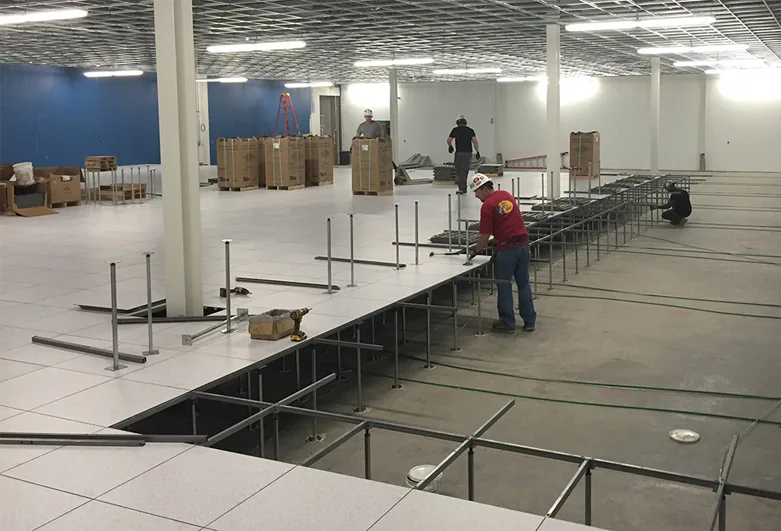
Data center floor leveling is surveying a raised access floor and correcting it so the panel grid is flat, square, and stable. The work adjusts threaded pedestal heights, re-seats or re-torques stringers, replaces damaged or warped panels, and re-squares grids that have drifted after years of cutouts. Typical specifications call for roughly 1/16 in. of variation in 10 ft and about 1/8 in. or less across the whole floor. You need it when panels rock, joints open up, or heavier equipment is headed onto an older floor.
What We Provide
Related Solutions
Floor Survey and Leveling
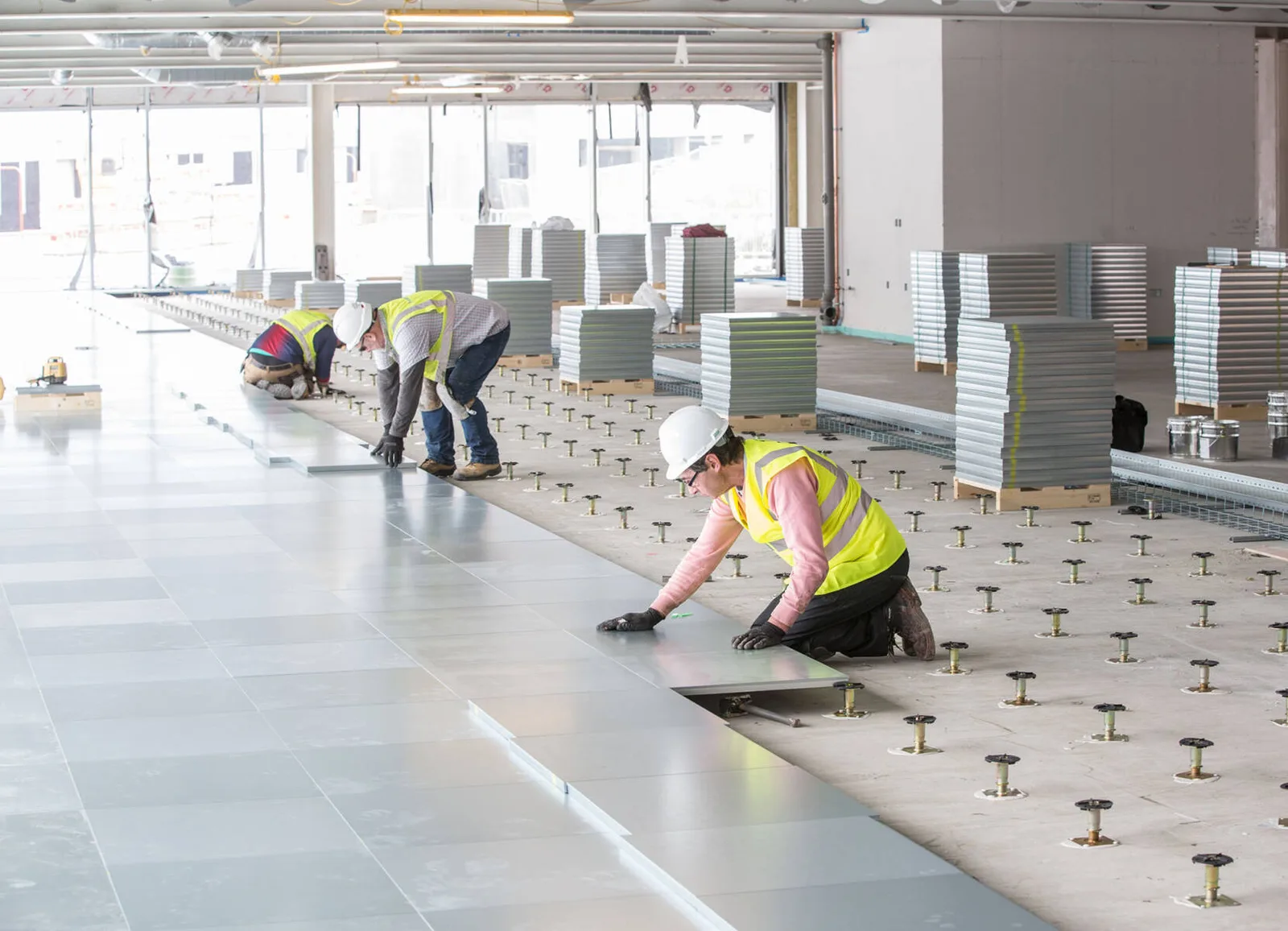
We survey the floor, then reset pedestals, re-seat stringers, and re-square the grid in sections while the room stays live.
Learn moreMatched Replacement Panels
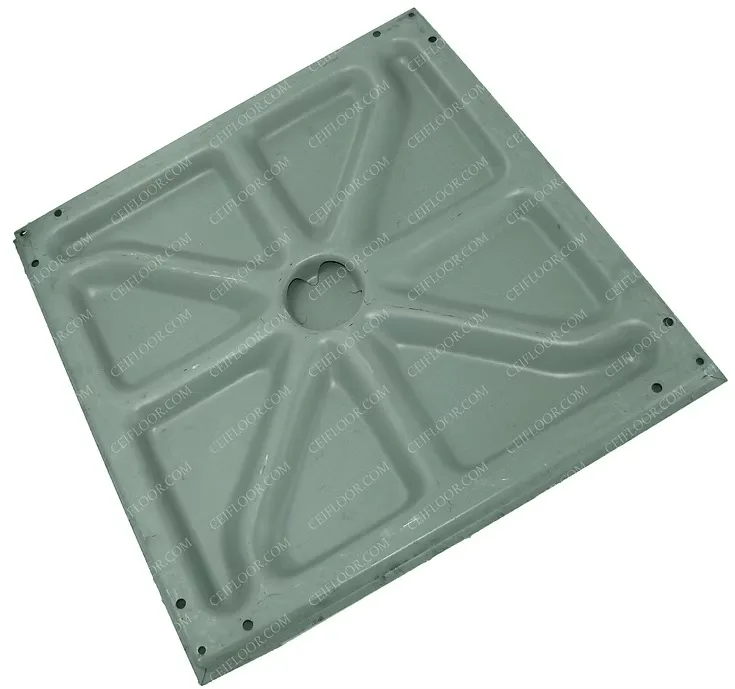
We identify your existing system and supply CEI replacement panels that match its core, height, and mounting.
Learn moreUnderstructure and Airflow
We replace failed pedestals and stringers and restore airflow panels as part of the same repair.
Learn moreHow Leveling Works
Pedestals, Stringers, and a Flat Panel Grid
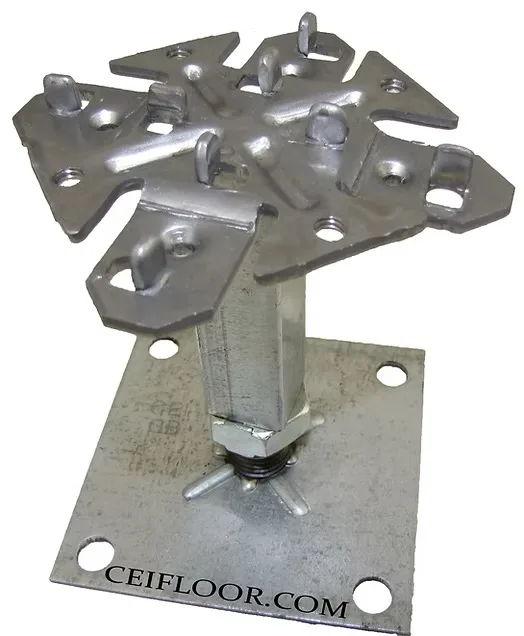
A raised floor is only as level as its understructure. Pedestal shafts are threaded for height adjustment (the federal UFGS 09 69 13 guide specification calls for about 2 in. of adjustment range) and use locking devices to hold the setting. Pedestals are secured to the slab with adhesive or anchors, and stringers interlock with the pedestal heads to keep the grid from shifting sideways.
Leveling means surveying the floor, finding the high and low points, and bringing them back into tolerance: resetting and locking pedestal heights, re-seating or re-torquing stringers, replacing damaged or warped panels, and re-squaring a grid that has drifted after many cutouts and changes.
Commonly specified tolerances are tight. UFGS 09 69 13 calls for the floor to be level within 0.060 in. in 10 ft, 0.100 in. across the entire floor, and 0.030 in. across panel joints. One major manufacturer's guide specification allows no more than 0.062 in. in 10 ft or 0.125 in. overall.
Why Floors Drift
What Causes a Rocking or Uneven Raised Floor
Published causes of an uneven or rocking floor include missing edge trim, improper installation, incorrect cutouts, loose lateral braces, and dramatic temperature changes. Repeated heavy rolling loads can warp panels, wood-core panels can swell after water exposure from spills, sprinkler discharge, or humidity swings, and water can weaken the adhesive that holds pedestals to the slab.
Other causes are common in the field: failed pedestal adhesive, lock nuts that back off over time, mixed panel types or thicknesses from piecemeal replacement, and slab movement. A survey identifies which of these is behind the problem, so the repair addresses the cause rather than the symptom.
Good owner care prevents much of this. One manufacturer's owner's manual advises leaving pedestal adjustments and stringers undisturbed while panels are out, lifting panels with proper panel lifters (never screwdrivers or pliers), protecting the floor with plywood or load-distributing sheets when moving heavy equipment, and keeping cutouts at least 3 in. from the panel edge.
Level and Load
An Uneven Floor Under Heavy Racks Is a Load Warning
When a floor starts to rock or settle under new, heavier racks, the question is load as well as level. Panel ratings come from standard tests: concentrated load on a 1 sq in. area at the panel's weakest point (common classes run from 1,000 to 2,500 lb), uniform load per square foot, rolling load with small casters over 10 passes and larger wheels over 10,000 passes, and ultimate load, the load at failure, well above the rated load. Specifications commonly call for pedestals rated for 5,000 to 6,000 lb of axial load.
Understructure changes the result. In one manufacturer's published data, the same 1,000 lb wood-core panel is listed at 1,500 lb ultimate on a stringerless system, 2,000 lb on a cornerlock system, and 2,950 lb on a bolted stringer system.
Comp-Utility surveys the floor before quoting, then levels it in sections, usually while the room stays live, and matches any replacement panels to your existing system so the repaired area sits flush.
Key Specifications
| Measure | What It Means | Commonly Specified |
|---|---|---|
| Level over 10 ft | Maximum variation across any 10 ft of floor | 0.060 in. (UFGS 09 69 13); 0.062 in. (one manufacturer guide spec) |
| Level across the floor | Maximum variation across the entire floor | 0.100 in. (UFGS 09 69 13); 0.125 in. (one manufacturer guide spec) |
| Panel joints | Height difference across adjacent panel joints | 0.030 in. (UFGS 09 69 13) |
| Pedestal adjustment | Threaded height adjustment range | About 2 in. (UFGS 09 69 13) |
| Concentrated load | Load on a 1 sq in. area at the panel's weakest point | Common classes from 1,000 to 2,500 lb |
| Uniform load | Load per square foot across the panel | Rated per panel and load class |
| Rolling load | Small casters at 10 passes; larger wheels at 10,000 passes | Rated per panel and load class |
| Ultimate load | Load at which the panel fails | Well above the rated load |
| Pedestal axial load | Vertical load a single pedestal supports | 5,000 to 6,000 lb |
Figures are commonly specified values from the federal UFGS 09 69 13 guide specification and published manufacturer guide specifications, not a Comp-Utility standard. Your project specification and the floor manufacturer's data govern.
The Comp-Utility Difference
Why Comp-Utility?
Engineer-Owned and Operated
Comp-Utility is owned and operated by engineers, with licensed Texas Professional Engineers (P.E.) on staff. That rigor anchors every design, specification, and installation.
Trusted Since 1992
We have designed, installed, and maintained mission-critical power and cooling infrastructure across Central Texas since 1992, through every generation of the technology.
Turnkey, Single-Contract Partner
We sell, design, install, and maintain complete infrastructure end to end. One accountable team and one contract for power, cooling, distribution, and cabling.
Long-Standing Distribution Partner
As a long-standing distribution partner of Eaton, Schneider Electric, and Vertiv, we specify best-in-class systems and back them with factory-grade service.
Licensed, Certified & Recognized
We hold ourselves to the standards of the institutions we serve, from professional licensure and jobsite safety to the industry organizations that set the bar for mission-critical work.

Licensed Professional Engineers
State of Texas (TBPE)
OSHA 30 Certified
Field Technicians

AFCOM Member
Data center industry association

7x24 Exchange Member
Mission-critical infrastructure
Frequently Asked Questions
What is data center floor leveling?
Data center floor leveling is surveying a raised access floor and correcting it so the panel grid is flat, square, and stable. Technicians adjust and lock threaded pedestal heights, re-seat or re-torque stringers, replace damaged or warped panels, and re-square grids that have drifted after many cutouts. The goal is a floor within its specified tolerances, with no rocking panels or open joints.
How level does a raised access floor need to be?
Specifications vary, but typical specs call for roughly 1/16 in. of variation in 10 ft and about 1/8 in. or less across the whole floor. The federal UFGS 09 69 13 guide specification, for example, calls for 0.060 in. in 10 ft, 0.100 in. across the entire floor, and 0.030 in. across panel joints. Your project specification and the floor manufacturer's data govern.
Why do raised floor panels rock or sit unevenly?
Common causes include missing edge trim, improper installation, incorrect cutouts, loose lateral braces, and dramatic temperature changes. Repeated heavy rolling loads can warp panels, and wood-core panels can swell after water exposure. In the field we also see failed pedestal adhesive, lock nuts that have backed off, mixed panel types or thicknesses from piecemeal replacement, and slab movement. A survey finds the actual cause.
Can a raised floor be leveled while the data center is running?
Usually, yes. Leveling is typically done in sections, lifting a limited number of panels at a time so the rest of the floor stays in place and the room stays live. Work near active racks and airflow panels is planned around cooling and access. Comp-Utility surveys the floor first and sequences the work to fit your operations.
What do concentrated, uniform, rolling, and ultimate load mean?
Concentrated load is a load on a 1 sq in. area at the panel's weakest point, with common classes from 1,000 to 2,500 lb. Uniform load is spread per square foot across the panel. Rolling load is tested with small casters over 10 passes and larger wheels over 10,000 passes. Ultimate load is the load at which the panel fails, well above its rated load.
Does the understructure affect a panel's load rating?
Yes. The same panel rates higher on a bolted stringer system than on a stringerless one. In one manufacturer's published data, a 1,000 lb wood-core panel is listed at 1,500 lb ultimate stringerless, 2,000 lb on a cornerlock system, and 2,950 lb on bolted stringers. Specifications also commonly call for pedestals rated for 5,000 to 6,000 lb of axial load.
Is an uneven floor a sign of a load problem?
It can be. If panels start to rock, deflect, or settle after heavier racks or equipment arrive, the floor may be carrying more than its panels or understructure were specified for, and leveling alone will not fix that. Comp-Utility checks the panel load class and understructure during the survey and recommends reinforcement or higher-rated panels where the loads require it.
How can I keep a raised floor level?
Leave pedestal adjustments and stringers undisturbed while panels are out, lift panels with proper panel lifters rather than screwdrivers or pliers, and protect the floor with plywood or load-distributing sheets when moving heavy equipment. Keep cutouts at least 3 in. from the panel edge, and when replacing panels, match the existing system and core type rather than mixing products.
Who levels and repairs raised access floors in Central Texas?
Comp-Utility installs, levels, and repairs raised access floors across Central Texas and supplies CEI panels and matched replacement panels. We survey the floor before quoting, and field work is performed by our full-time W-2 crew members. Engineer-owned since 1992. Call (512) 346-0999 or email sales@comp-utility.com to schedule a survey.